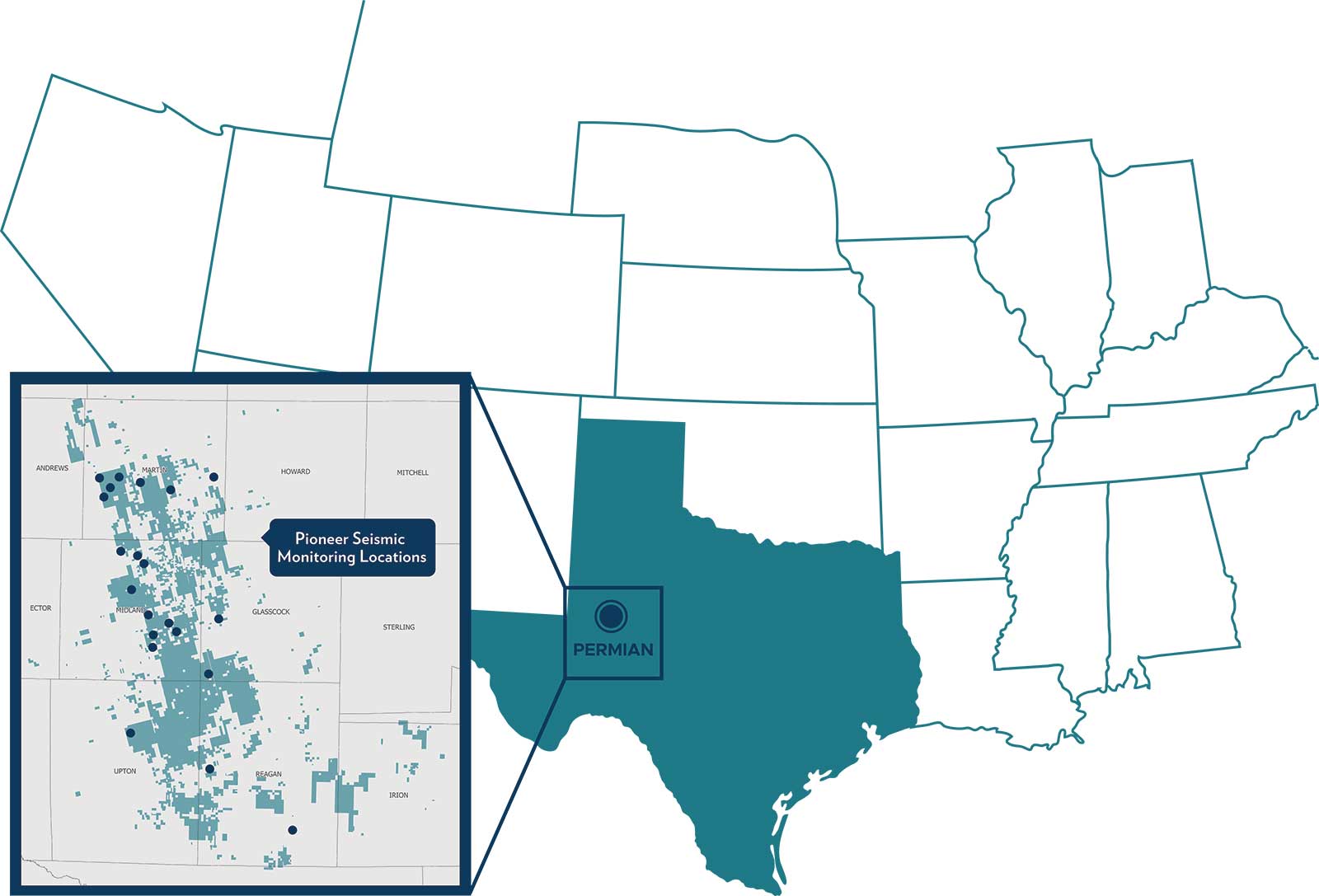
Research has shown that active management of produced water disposal and seismic monitoring are useful tools to understand induced seismicity (Ellsworth, 2013*). At Pioneer, we use both techniques. Pioneer approaches issues of seismicity proactively by using scientific analysis and collaborating with regulators and researchers. Since 2017, we have monitored seismicity using a proprietary network of monitoring sensors in the Midland Basin, supplemented by Texas’ TexNet Seismic Monitoring and the U.S. Geological Survey Earthquake Hazards Program. In the last two years, we have installed additional sensors throughout the Midland Basin. These seismometers allow us to better understand earthquakes and related risks.
Pioneer complies with federal and state regulations regarding underground injection control. We actively engage with state regulators and industry groups, including the Texas Railroad Commission, to address seismicity concerns. Pioneer works closely with other operators and the Texas Railroad Commission to develop science-based approaches addressing seismicity, create contingency responses for seismic events and determine how to best work with regulatory agencies.
Recently increased seismic activity has been observed throughout the Permian Basin. Proactive industry collaboration with state regulators and research institutions has contributed to mitigation actions by the Texas Railroad Commission. These efforts have promoted operational transparency, increased seismic monitoring and allowed for continued responsible disposal operations, along with disposal restrictions in certain areas of the basin.
Although very few of Pioneer’s disposal wells have been impacted by regulatory restrictions, we take a proactive approach to address seismic activity in our areas of operation. In Seismic Investigation Regions, as defined by the Texas Railroad Commission, we use our water infrastructure and third-party takeaway to provide flexibility in water reuse and alternative disposal options away from these regions. The primary focus is to use produced water for completions operations, followed by alternate disposal zones or regions that do not contribute to seismicity. Additionally, we continue to evaluate desalination technologies that could provide a better long-term solution for produced water that cannot be reused in our operations. Using the 46latest science and taking advantage of our extensive subsurface data to improve our operational knowledge, Pioneer incorporates seismicity risks in the election of both our future production and disposal well locations. We contribute funding and provide data to leading independent seismological researchers at the Stanford Center for Induced and Triggered Seismicity and the University of Texas Center for Induced Seismicity Research. In 2022, Stanford Center for Induced and Triggered Seismicity research made important scientific contributions regarding seismicity risk. Specifically, the researchers gained insight into the management of injection-induced seismic risk, and the use of machine learning for induced seismicity using local, regional and international case studies.
Additionally, our collaboration with the University of Texas Center for Induced Seismicity Research has continued to provide research and resources regarding the characteristics and mechanisms of seismicity, subsurface interpretation, basin modeling, engineering and hydrology.